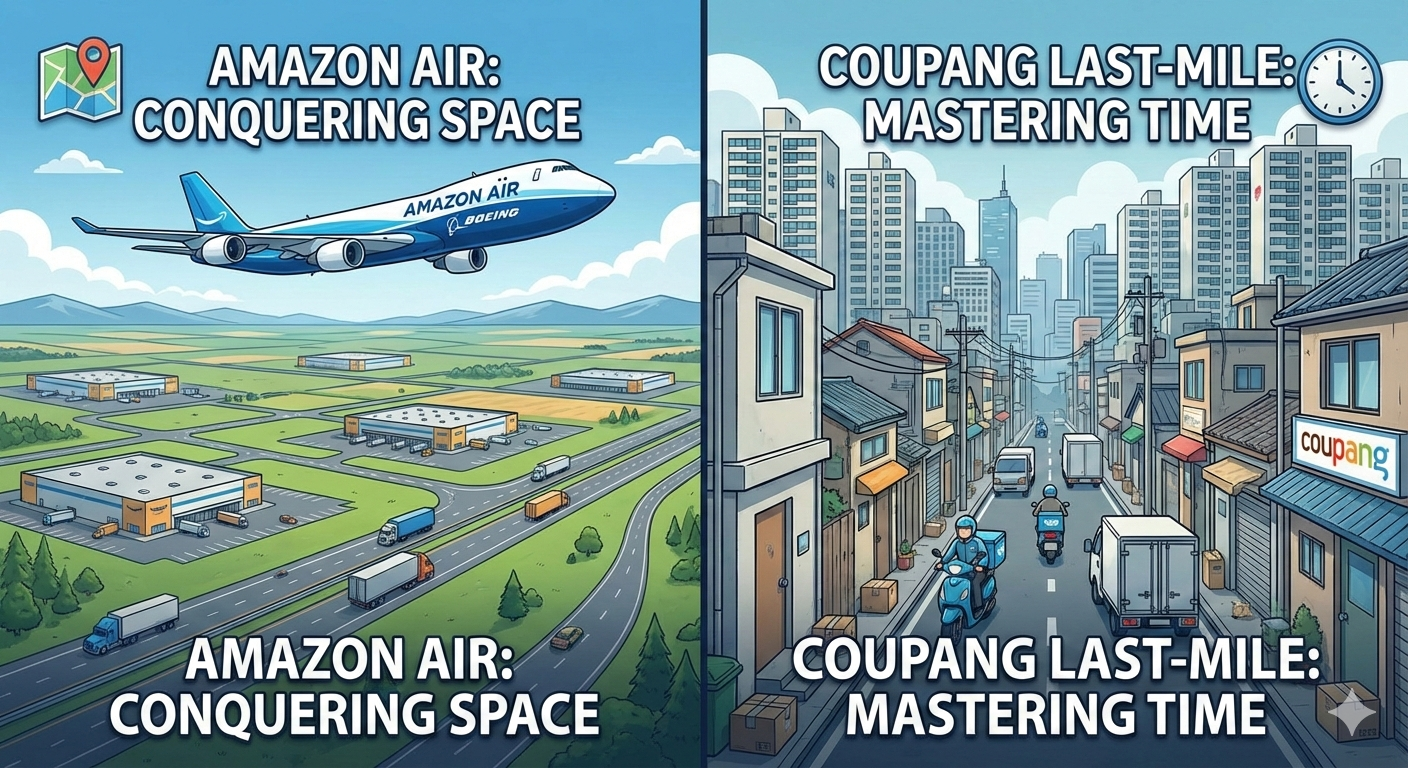
When I moved from managing middle-mile aviation logistics at Amazon Air in the U.S. to managing Coupang’s last-mile division in South Korea, my career essentially moved “from the sky to the alleys.” People often call Coupang the “Amazon of South Korea,” but as an insider who has lived in both machines, I can tell you the operational philosophies are fundamentally different. At the heart of this difference are two variables: Geography and Density.
1. Amazon: Conquering Space through Regionalization
In the vast landscape of the United States, the primary enemy of “Prime” speed is distance. However, Amazon doesn’t achieve 1-2 day delivery simply by flying every package across the continent.
The Real Engine: Regionalization of Inventory
Amazon’s true secret is a self-sufficient regional model. They have divided the U.S. into distinct regions and use AI to forecast demand locally. By placing inventory in a Fulfillment Center (FC) just a few miles from the customer, they ensure the majority of orders never need to cross state lines.
The True Role of Amazon Air: The Long-Tail Bridge
So, where do the planes come in? Amazon Air isn’t for your everyday household items; it’s for the “Long-Tail.” If a customer in Texas wants a niche item available only in a Seattle warehouse, the regional ground network fails. Amazon Air acts as the critical safety valve. It bridges the gap for national selection, ensuring that even if an item is 3,000 miles away, the Prime promise remains unbroken.
2. Coupang: Mastering the Final Meter in a Vertical World
In South Korea, the challenge isn’t distance. It’s extreme urban density and friction. While Amazon focuses on “Space,” Coupang focuses on “Time.” Because over 70% of the Korean population lives within 7 miles of a fulfillment center, the logistics challenge shifts entirely to the “Final Meter.”
The Apartment Challenge vs. The American Porch
In the U.S., a delivery often ends at the porch, a horizontal, straightforward drop-off. In South Korea, where the majority live in high-rise apartments, the “Last-Mile” is a vertical puzzle. My role involved navigating the incredible detail of this final step: from managing complex digital security codes to navigating narrow corridors and high-security building access.
Coupang’s moat is built on vertical integration. By owning the entire chain, from the warehouse shelf to the “Coupang Friend” (the driver) at the door, they can standardize an experience that involves far more “human” friction than the average U.S. delivery.
3. Leadership Insight: Efficiency is Relative
The most profound lesson I learned is that efficiency is relative to your environment. Amazon built a world-class airline because it had to conquer a continent to provide national selection. Coupang built a world-class “Rocket” system because it had to conquer time and density in a hyper-urban society.
Both companies use similar technologies, but the application is shaped by the land. True global leadership isn’t about taking a corporate manual from one country and “installing” it in another. It is about the ability to redesign the system to fit the local geography. Whether you are managing planes in the sky or drivers in the alleys, the goal remains the same: making the physical distance between a product and a customer disappear.